Fire and Silica: Inside the Workshops of Murano's Glass Masters
From millefiori beads to architectural chandeliers, the glassblowing techniques born on a Venetian lagoon island still define Italian luxury.
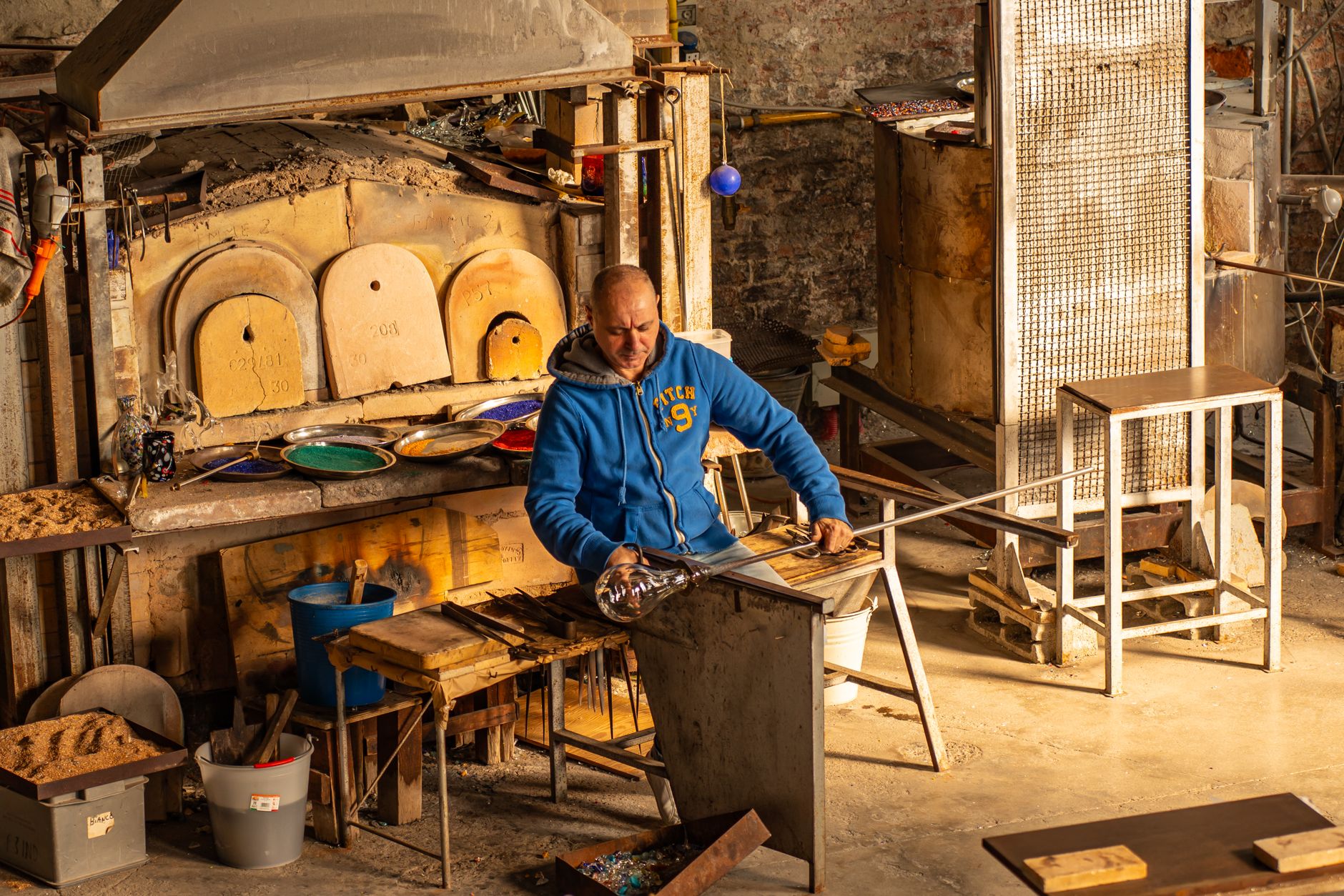
The Republic's Secret Weapon
In 1291, the Venetian Republic exiled its glassmakers to Murano—a cluster of islands northeast of the city—ostensibly to prevent workshop fires, but really to guard state secrets. The gambit worked. For seven centuries, Murano glass artisans have refined techniques so specialized that even today, certain methods exist nowhere else. The result isn't just decorative objects; it's a material language that luxury houses from Chanel to Dolce & Gabbana periodically borrow, never quite replicating the original.
The island's workshops produce everything from thumb-sized perfume stoppers to three-metre chandeliers, but the process remains defiantly analogue. No machines. No shortcuts. Just furnaces that burn at 1,400°C and knowledge passed maestro to apprentice.
Techniques That Can't Be Taught by Manual
What separates Murano glass artisans from other glassblowers is a repertoire of methods developed when Venice controlled Mediterranean trade routes. These aren't techniques you learn from YouTube tutorials.
Millefiori ("thousand flowers") involves fusing coloured glass canes into rods, then slicing them to reveal kaleidoscopic cross-sections. Each cane requires separate preparation; a single bead might contain thirty distinct patterns. The method dates to Roman glassmaking but was perfected on Murano in the fifteenth century, when the island's artisans figured out how to create impossibly fine detail at scale.
Lattimo produces opaque white glass that mimics porcelain—a fifteenth-century innovation designed to compete with Chinese imports. The secret ingredient is bone ash or tin oxide, but the real skill lies in temperature control. Too hot and the glass turns translucent; too cool and it fractures.
Sommerso ("submerged") creates layered colour effects by dipping molten glass into differently pigmented crucibles. Venini, the Murano house founded in 1921, built its reputation on sommerso pieces in the 1930s, when designer Paolo Venini pushed the technique toward sculptural abstraction. His work now sits in MoMA's permanent collection, but contemporary artisans still use the same method for jewelry and decorative objects.
Other essential methods include:
- Filigrana: embedding fine threads of white or coloured glass into clear crystal, often in spiral patterns
- Incalmo: fusing separate blown sections with different colours into seamless forms
- Murrine: similar to millefiori but with geometric rather than floral patterns
- Avventurina: suspending copper crystals in molten glass to create a shimmering, almost metallic finish
Why Luxury Brands Keep Returning
When Dior wanted hardware for its Spring 2021 bags, the house commissioned Murano glass artisans to create striped resin-and-glass rings in signature colours. The pieces weren't entirely glass—modern regulations and weight considerations required hybrid construction—but the colour gradation and finish bore Murano's fingerprints. Similarly, Dolce & Gabbana's Alta Moda collections frequently feature Murano chandelier earrings, each pair requiring hours of lampwork (the technique of shaping glass over a small torch rather than in a furnace).
The appeal is partly provenance, but mostly materiality. Murano glass has a clarity and refraction index that differs from Czech crystal or French pâte de verre. Light behaves differently. Colours sit deeper. The weight distribution in a blown bead versus a moulded one is immediately perceptible to anyone who handles jewelry regularly.
There's also the question of what can't be replicated. A maestro vetrario spends a decade learning to judge viscosity by sight, to know when glass is 50 degrees too cool just from how it moves on the pipe. That tacit knowledge doesn't scale, which is precisely why it retains value in an era of 3D-printed everything.
The Workshop Reality
Murano today operates about seventy active furnaces, down from several hundred in the industry's twentieth-century peak. Tourism keeps many workshops afloat—glass demonstrations are a Venetian cliché—but serious production continues in less visible studios. These are the places supplying components to jewelry ateliers in Milan and Paris, creating limited-edition collaborations, training the next generation.
Younger Murano glass artisans face the usual tension between preservation and innovation. Some experiment with industrial materials or digital design templates; others insist on reproducing sixteenth-century techniques with fanatical accuracy. Both approaches coexist, which is probably healthy. The work that endures tends to split the difference: historical methods applied to contemporary forms, old secrets in new contexts.
The island's glass isn't going anywhere. As long as luxury operates on principles of scarcity, skill, and irreproducibility, there's a place for objects that can only be made one way, in one location, by people who've spent half their lives learning how.