The Alchemy of Time: Inside the World's Great Heritage Perfume Houses
From Grasse laboratories to Parisian ateliers, the founding stories and enduring formulas that shaped modern fragrance.
The scent you wear carries more history than the vintage Hermès Kelly on your arm.
The Architecture of Memory
When we talk about heritage perfume houses, we're not simply cataloguing old bottles. We're tracing the lineage of olfactory innovation, from the moment Pierre-François Pascal Guerlain opened his boutique at 42 rue de la Paix in 1828 to the contemporary interpretations that still bear his family's imprint. These houses didn't merely survive centuries; they authored the very grammar of modern perfumery.
Guerlain's Jicky, created in 1889, remains instructive. It was among the first to employ synthetic materials alongside naturals, a radical move that scandalized purists but liberated perfumers from the constraints of harvest seasons and geography. The coumarin accord that defines it smells simultaneously of cut hay, vanilla, and something ineffably modern. Aimé Guerlain wasn't chasing trends; he was inventing them.
Meanwhile, at Caron, Ernest Daltroff and his creative partner Félicie Wanpouille were approaching scent as haute couture. Their 1934 creation, Pour un Homme, introduced lavender and vanilla in a way that rewrote the rules for men's fragrance. The original Baccarat flacons, with their gold-dipped stoppers, weren't affectation. They signalled that what lay inside deserved the same reverence as a couture gown.
Formulas That Refused to Fade
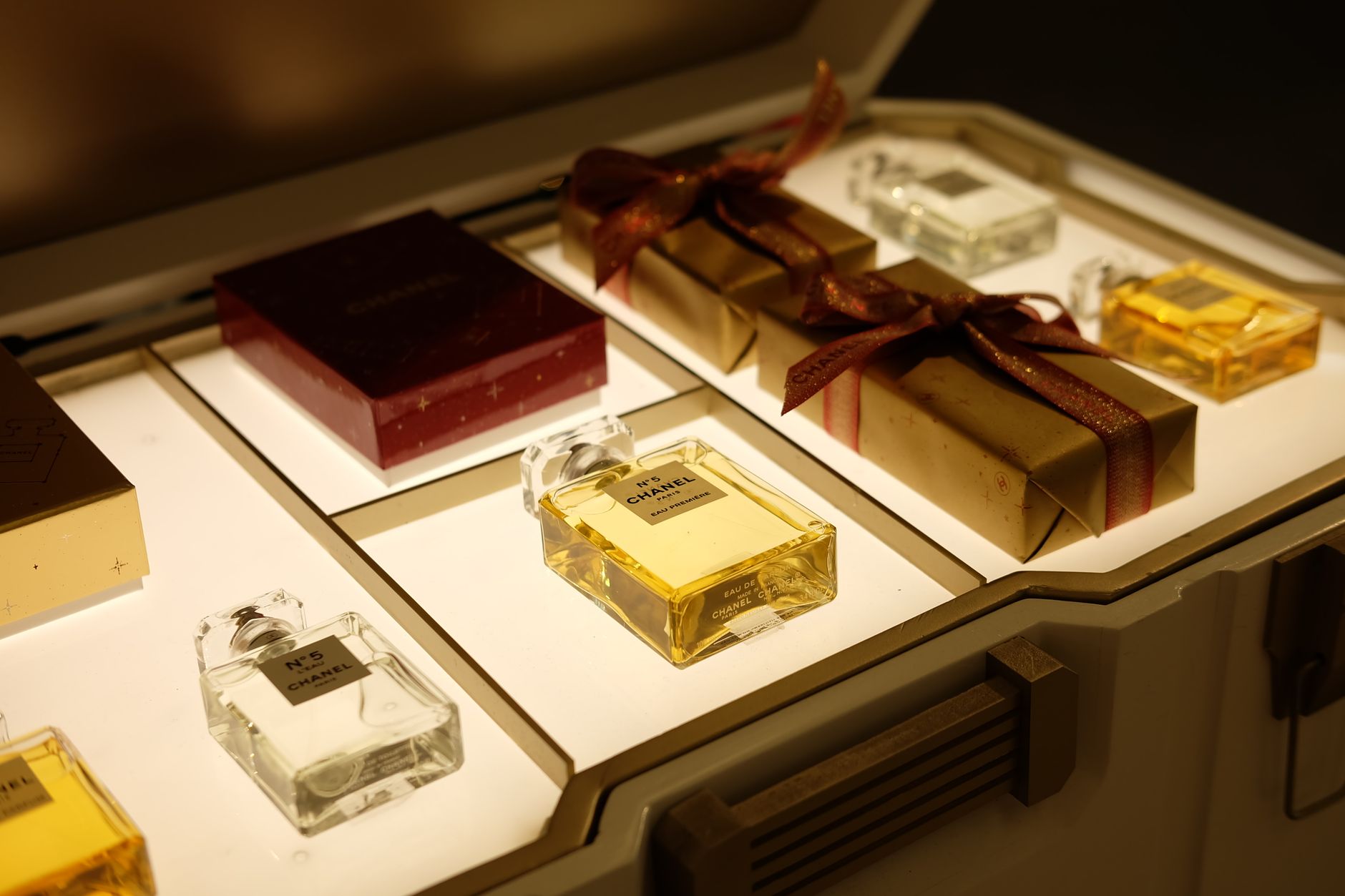
The true measure of heritage perfume houses lies not in their archives but in their resistance to reformulation for the sake of cost or fashion. Chanel No. 5, composed by Ernest Beaux in 1921, has weathered nearly every seismic shift in beauty culture without losing its spine. Yes, IFRA regulations have necessitated adjustments to certain aldehydes and naturals, but the skeletal structure, that abstract floral shimmer, endures.
What Coco Chanel understood, and what the house still honours, is that great fragrance doesn't announce itself with a single note. No. 5 doesn't smell like roses or jasmine, though both are present in Grasse-grade concentrations. It smells like Chanel No. 5, a feat of compositional alchemy that's proven impossible to replicate despite countless attempts.
Similarly, Shalimar by Guerlain (1925) remains the platonic ideal of the oriental category. Jacques Guerlain's use of synthetic vanillin and ethyl vanillin created a gourmand base decades before the term existed. The bergamot and lemon opening, the iris and jasmine heart, the balsamic vanilla-tonka-incense base: it's a structure so perfectly balanced that modern perfumers still study it like architects analysing the Panthéon.
The Artisan's Hand in an Industrial Age
What distinguishes heritage perfume houses in 2025 isn't simply longevity. It's their retention of savoir-faire in an industry increasingly dominated by focus groups and influencer seeding. At Houbigant, founded in 1775, the same Fougère Royale formula created by Paul Parquet in 1882 established an entire fragrance family. The fougère accord (lavender, geranium, coumarin, oakmoss) became so foundational that nearly every men's fragrance since has paid it homage, consciously or otherwise.
Consider what this continuity requires:
- Archival integrity: original formulas preserved in handwritten ledgers, not just digital files
- Supplier relationships: multi-generational partnerships with Grasse rose growers, Calabrian bergamot estates, Bulgarian lavender farms
- In-house expertise: perfumers trained in classical composition before exploring contemporary riffs
- Patient capital: shareholders who measure success in decades, not quarters
These aren't romantic luxuries. They're structural necessities for houses that view fragrance as patrimoine, not product.
Wearing History Without the Weight
The beauty of shopping heritage perfume houses today is that you're not relegated to museum-piece scents. Dior's Maison Christian Dior collection reinterprets the house codes established by Edmond Roudnitska with Eau Sauvage and Diorissimo through contemporary lenses. Hermès, under perfumer Christine Nagel, mines its equestrian and leather-working DNA without producing literal saddle-soap fragrances.
You're not buying nostalgia. You're buying the accumulated knowledge of generations of noses who understood that great fragrance operates on a different temporal plane than fashion. A well-chosen scent from a heritage house becomes part of your own story, layered atop the century of stories already contained in the bottle.
Which is precisely why, when someone asks what you're wearing, the answer carries weight beyond brand recognition. You're wearing craft, history, and a particular vision of beauty that refused to compromise. That's worth far more than any logo.